


Cervical osteochondrosis is a degenerative-dystrophic disease in the tissues of the articular cartilage, which can be localized in any joints, as well as in the intervertebral disc.The cervical spine is subjected to heavy loads, which over time leads to a decrease in the elasticity of the discs and their flattening.The distance between the vertebrae decreases, blood circulation in the affected area worsens, and pain appears in the cervical spine.


Causes of osteochondrosis
The main reason for the development of osteochondrosis is the uneven and excessive load on the cervical vertebrae.Strain can occur due to excess weight, long time in an uncomfortable position or during sedentary work.Osteochondrosis is not always the result of direct stress on the vertebrae.The disease can be caused by metabolic disorders, deficiency of vitamins B, C, D, as well as hormonal and autoimmune diseases, chronic intoxication, injuries and age-related changes.
At the moment, there is no exact data on the causes of degenerative diseases of the spine.Osteochondrosis can occur as a result of a number of reasons:
- genetic factor - congenital weakness of the connective tissue;
- age-related changes in the spine;
- diseases of the musculoskeletal system (scoliosis, flat feet, torticollis, rheumatic diseases, developmental anomalies);
- vertebral instability (increased mobility of part of the spine);
- low physical activity;
- cervical spine injuries;
- heavy physical exertion, carrying heavy objects.
Stages of osteochondrosis
Treatment of cervical osteochondrosis depends on the stage of development and clinical signs of the disease.Each stage is characterized by certain characteristics:
- Stage 1 - destruction of the osteochondral tissue occurs.At this stage, patients do not notice the symptoms of the disease.This can be discomfort, pain in the cervical vertebrae, pain during movement.
- Stage 2 – MRI reveals protrusions of the intervertebral discs, compression of the spinal roots (radicular syndrome).The changes that occur cause pain in the cervical spine with radiation to the shoulder and upper extremities.Associated symptoms include increased fatigue, headaches and difficulty concentrating.
- Stage 3 – painful sensations intensify and are constant, radiating to the upper part of the body.There is numbness in the hands, weakness in the muscles of the upper limbs, often one side of the body is affected.
- Stage 4 – the bone tissue is replaced, an osteophyte is formed and the neighboring joints are damaged.
Clinical manifestations
General signs of cervical osteochondrosis:
- pain in the cervical vertebrae;
- radiculopathy - compression of the nerve roots, which is manifested by pain, sensory disturbances and muscle weakness;
- numbness of the upper limbs appears;
- pain in the cervical region radiating to the back of the head, dizziness.
Diagnosis
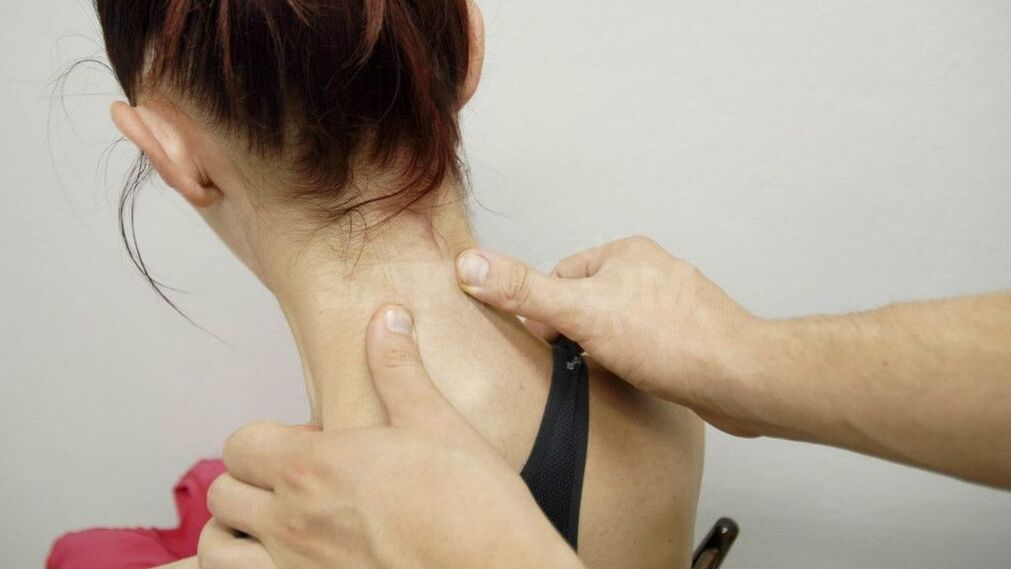
The examination includes collection of anamnestic data, complaints, examination and palpation of the cervical spine, and assessment of neurological status.To determine the available changes and the stage of the disease, digital radiography, MRI and CT and Doppler echography of the main cerebral arteries (USG) are performed.Diagnosis allows the specialist to create an effective treatment regimen.
Treatment of osteochondrosis
To achieve the most positive results and delay the progression of the disease, complex treatment is carried out.The treatment combines drug therapy with physiotherapeutic procedures, massage, acupuncture, manual therapy, apparatus traction of the cervical vertebrae and therapeutic gymnastics.
Chance collar
In the period of exacerbation of cervical osteochondrosis, it is prescribed to wear a special orthopedic device - Shantz's collar.The main purpose of the product is to fix the cervical spine in the correct position.
Surgical treatment
Surgical intervention is indicated in cases where medication and physical intervention are unavoidable.People turn to him if the patient's spinal canal has become catastrophically narrow.
Surgical intervention is performed to remove a hernia, replace a destroyed intervertebral disc with an implant and expand the spinal canal.
Massage for cervical osteochondrosis
Massage allows you to relax the muscles, improve blood circulation in the affected area and reduce the load on the vertebrae.Massage, combined with exercise and other treatments, helps relieve pain.
Massage is performed when pain is reduced or pain is regressed, in the stabilization stage.
The procedure is performed by a qualified specialist to relieve muscle tension, pain and improve blood circulation.During the massage, stroking, rubbing, kneading and other techniques from the classic massage techniques are performed.
During the exacerbation period, electrophoresis, magnetic therapy, ultrasound using glucocorticoids, magnetic laser and SMT with anesthetic are prescribed.
Basic exercises for the treatment of cervical osteochondrosis
Basic exercises for the treatment of cervical osteochondrosis:
- i. p.– lying on your stomach, palms resting on the floor, arms straight, the upper part of the body should be raised, arching in the back, hold for a few minutes;
- i. p.– lying on your stomach, arms straight beside the body, you need to turn your head left-right, trying to reach your ear to the floor;
- i. p. - sitting on the floor, inhale - bend forward to the chest, exhale - bend back, throwing your head back.
Manual therapy
The impact of the chiropractor's hands on the spine allows you to increase the distance between the vertebrae, as a result of which the load decreases.It is prescribed by the attending physician after radiography, MRI or CT.
Drug treatment
Treatment of cervical osteochondrosis is aimed at eliminating pain, the inflammatory process during exacerbation and preventing the progression of dystrophic changes in the structures of the spine.
For this purpose, local therapy with gels with an anti-inflammatory effect is used.
Medicines:
- NSAIDs.
- Muscle relaxants.
- Diuretics.
- Opioid analgesics.
- Therapeutic drug blockades with anesthetics or corticosteroid drugs and drugs that correct blood microcirculation.
- Metabolic therapy (group B vitamins, thioctic acid preparations).
- Medicines that improve the conduction of nerve impulses.
In addition, chondroprotectors can be prescribed to improve the regeneration process.

Disease prevention
Prevention should consist of lifestyle correction - playing sports (swimming, yoga, fitness) to form a muscular corset, warming up the cervical spine, creating comfortable sleeping conditions (comfortable mattress and pillow).
To prevent exacerbation, it is necessary to undergo a preventive course of cervical and back massage 2 times a year, acupuncture and hardware traction of the cervical spine.
All these procedures are performed on an inpatient and outpatient basis.